
YOU ARE STARTING THE SECTION-BY-SECTION REVIEW OF THE OLD 4473. TO JUMP TO THE NEW/CURRENT 4473, GO TO SECTION 7.8 – CURRENT 4473 SECTION A PAGE 1
4473 Section A page 1
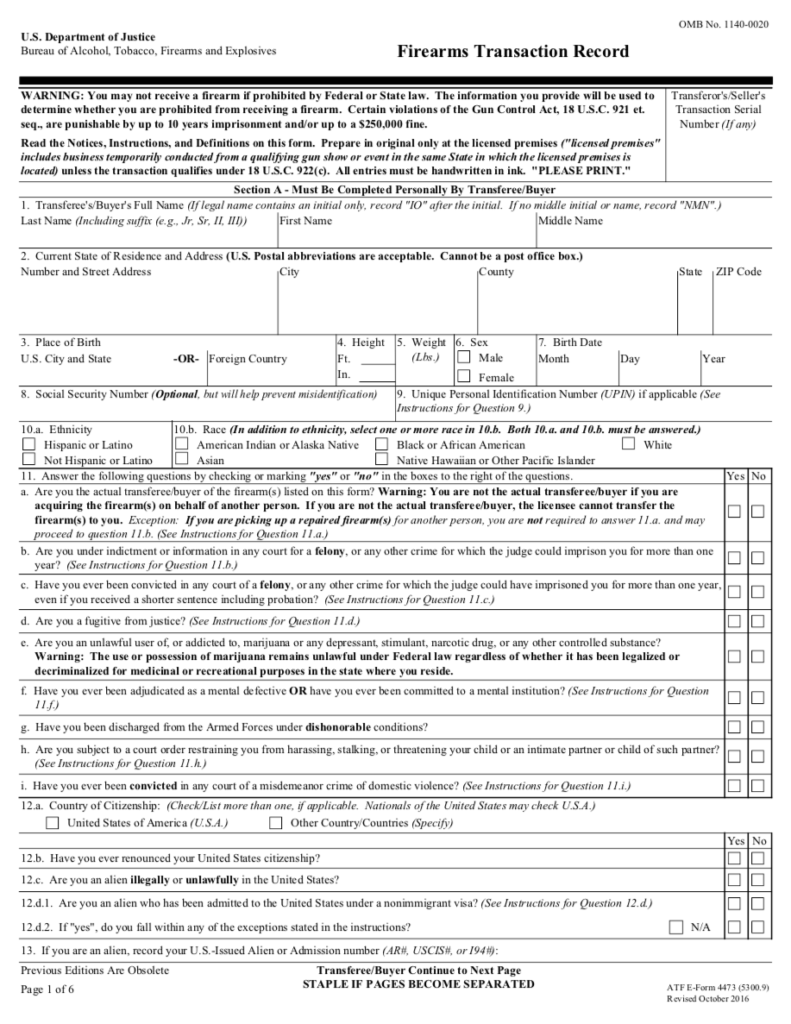
ONLY the customer, can fill out Section A of the old 4473 (see image below).
If the customer makes a mistake on this section that may be corrected (not #11) then only the customer may make the corrections.
If the corrections were made BEFORE the transfer, then the customer should have simply drawn a single line through the incorrect answer, entered the correct answer, and then initialed and dated the correct answer. If this was not done correctly, see the next part about corrections after the transfer (as this is the old 4473, all corrections from here on out will have been after the transfer).
If the corrections are made AFTER the transfer, then you must make a photocopy of the complete 4473 and then have the customer (and only the customer) draw a single line through the incorrect answer on the photocopy, enter the correct answer, and then initial and date the correct answer on the photocopy. Then, the photocopy with the corrections is attached to the back of the untouched original 4473.
I’ve seen numerous FFLs try to pre-fill the information on this form for their customers with the intention of providing a customer service benefit. DO NOT DO THIS! I’ve also seen FFLs highlight the sections (and even answers) that need to be filled in by the customer. The actual purchaser of the firearm, and ONLY that person, may fill out Part A of the 4473.
If there are questions, direct the customer to the instructions on the 4473. Trust me, you do not want to get into an issue where you’ve potentially coached a customer.
“If the buyer or transferee is unable to read and/or write, the answers (other than the signature) may be written on the form by another person, excluding the seller. Two persons not directly involved in the firearm transaction (excluding, for example, the licensee and employees of the licensee) must sign as witnesses to the buyer’s answers and signature.” – 27 CFR 478.21
Let’s review what needs to be included, along with potential problem areas, for each question.
- Transferee’s/Buyer’s Full Name. The customer’s name must exactly match their government issued photo ID. If it does not, due to a recent name change, have them get their ID corrected and then return with the new name. A supplemental ID will not work her – the primary ID must show their picture and full name. If they have no middle name, have them enter “NMN”
- Current State of Residence and Address. The purchaser must enter their CURRENT residential address. This may not be a P.O. Box regardless of what their ID shows – it must be for their residence. Likewise, if they live somewhere else, then the address on the ID can not be used even though it may be an actual home-based mailing address. This question asks for their county (e.g. Maricopa, Jones, etc.) and NOT their country (e.g. United States).
- Place of Birth. The purchase must enter their place of birth. Either a U.S. City/State OR a Foreign Country (not both).
- Height.
- Weight.
- Sex.
- Birth Date. This must match the primary photo ID. Note: pay attention to ensure they are old enough for the firearm(s). Federally, the law requires 18+ for long guns and 21+ for handguns.
- Social Security Number. Optional.
- Unique Personal Identification Number. If the purchaser has had issues with purchases previously, and they needed to appeal a NICS background check, they may have a UPIN number provided to them by the FBI. If this applies, they should enter this here.
- Ethnicity and Race.
- [Prohibiting Questions] The answers to these questions will determine whether the purchaser is lawfully allowed to possess firearms or ammunition. In order to proceed, 11a must be “yes” with one exception: it may be left blank if they are picking up a repaired firearm for someone else. If the purchaser is buying the firearm as a legitimate gift for someone else (i.e. they are not getting money, services, or anything else of value in exchange) and they have no reason to believe is a prohibited person, then they select “yes.” 11b-11i must be “no” in order to proceed. You should instruct your purchaser to take their time, read everything carefully, and be careful when answering this form. An incorrect answer here, even though it may be an honest mistake, is reason to stop the sale. The ATF’s new instructions on this form make it clear that the seller should stop the transaction. Also, even if you know the person and think it was a mistake, you open yourself up to serious liability if a mistake is corrected and something bad ever happens with the firearm(s).
- [Citizenship Questions]. Answer as appropriate. Do not forget 12a.