

4473 Section B pages 1 and 2
The customer, and ONLY the customer, can fill out Section B of the 4473.
If the customer makes a mistake on this section that may be corrected (not #21) then only the customer may make the corrections.
If the corrections are made BEFORE the transfer, then the customer simply draws a single line through the incorrect answer, enters the correct answer, and then initials and dates the correct answer.
If the corrections are made AFTER the transfer, then you must make a photocopy of the complete 4473 and then have the customer draw a single line through the incorrect answer on the photocopy, enter the correct answer, and then initials and date the correct answer on the photocopy. Then, the photocopy with the corrections is attached to the back of the untouched original 4473.
I’ve seen numerous FFLs try to pre-fill the information on this form for their customers with the intention of providing a customer service benefit. DO NOT DO THIS! I’ve also seen FFLs highlight the sections (and even answers) that need to be filled in by the customer. The actual purchaser of the firearm, and ONLY that person, may fill out Part A of the 4473.
If there are questions, direct the customer to the instructions on the 4473. Trust me, you do not want to get into an issue where you’ve potentially coached a customer (or even appeared to coach a customer). If they’re responsible enough to purchase a firearm, they are able to make their own decisions regarding how to fill out this form and following instructions.
“If the buyer or transferee is unable to read and/or write, the answers (other than the signature) may be written on the form by another person, excluding the seller. Two persons not directly involved in the firearm transaction (excluding, for example, the licensee and employees of the licensee) must sign as witnesses to the buyer’s answers and signature.” – 27 CFR 478.21
Here’s a sample of a properly completed sample Section B followed by instructions for each part:
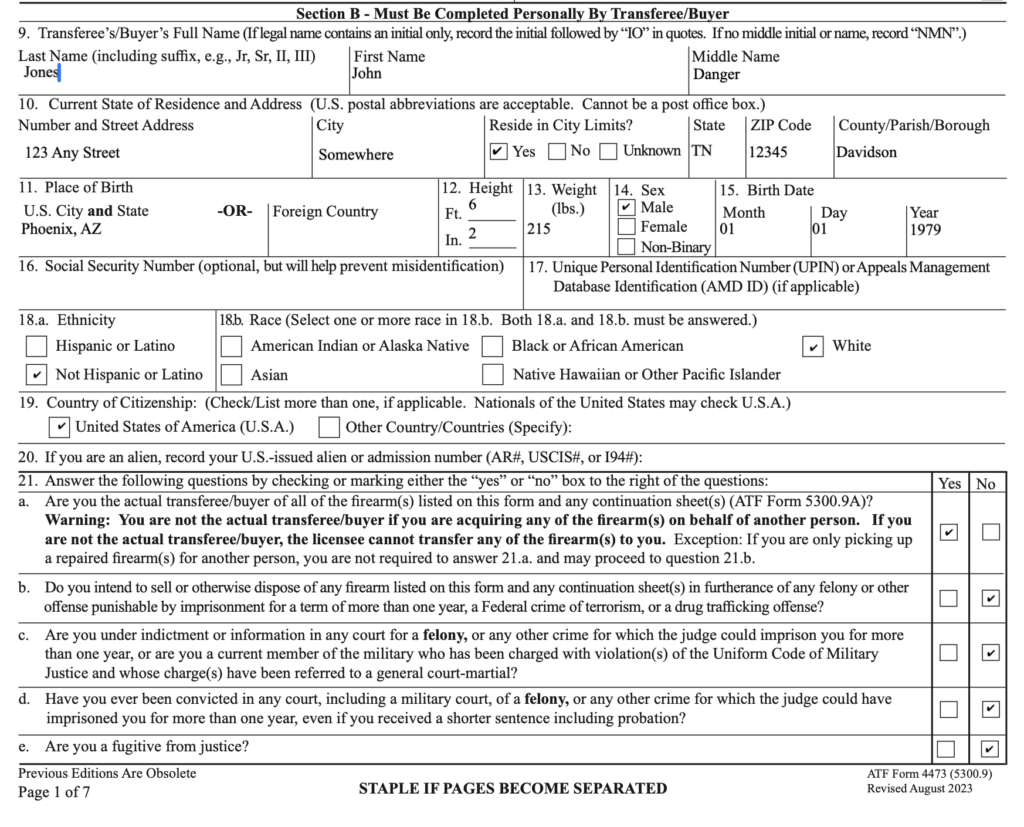
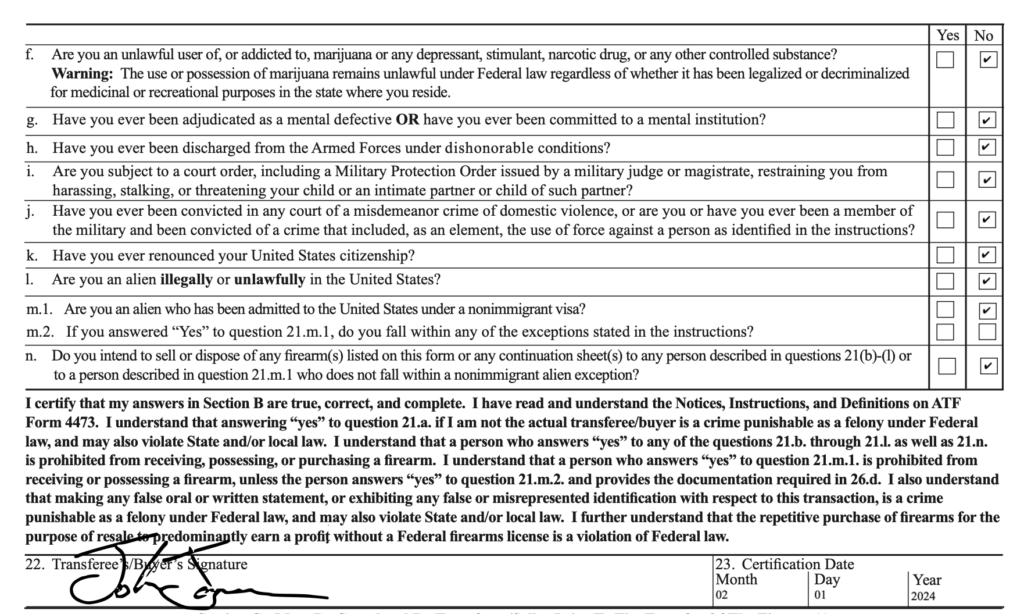
Let’s review what needs to be included, along with potential problem areas, for each question.
9. Transferee’s/Buyer’s Full Name. The customer’s name must exactly match their government issued photo ID. If it does not, due to a recent name change, have them get their ID corrected and then return with the new name. A supplemental ID will not work here – the primary ID must show their picture and full name. If they have no middle name, have them enter “NMN”
10. Current State of Residence and Address. The purchaser must enter their CURRENT residential address. This may not be a P.O. Box regardless of what their ID shows – it must be for their residence. Likewise, if they live somewhere else than what is listed on their ID, then the address on the ID can not be used even though it may be an actual home-based mailing address. Reside in City Limits? This new 4473 adds a question that determines whether or not the customer resides within city limits. This question asks for their County/Parish/Borough (e.g. Maricopa, Jones, etc.) and NOT their country (e.g. United States). This is much clearer on this current version of the 4473 (the old one only listed “County” which caused some confusion). They may abbreviate North, South, East, and West from their street address and also Road, Drive, Avenue, etc. but nothing else. This newest version of the 4473 includes a section about whether the customer lives within city limits.
11. Place of Birth. The purchaser must enter their place of birth. Either a U.S. City/State OR a Foreign Country (not both).
12. Height. The customer must enter their height in feet and inches (this should match their ID.
13. Weight. The customer must enter their weight in pounds.
14. Sex. This version of the 4473 (and the last one) now include “non-binary” as an option in addition to make and female. This selection MUST match their government issued photo ID. You may run into a customer service issue here if someone’s ID, for example, lists “female” and they select “non-binary” on the 4473. This is a problem because the info on the 4473 MUST match their ID. We encourage you to consider how you will handle this conversation before it happens because you may be dealing with an offended customer who refuses to fill out the form properly.
15. Birth Date. This must match the primary photo ID. Note: pay attention to ensure they are old enough for the firearm(s). Federally, the law requires 18+ for long guns and 21+ for handguns.
16. Social Security Number. Optional.
17. Unique Personal Identification Number. If the purchaser has had issues with purchases previously, and they needed to appeal a NICS background check, they may have a UPIN number provided to them by the FBI. If this applies, they should enter this here.
18. Ethnicity and Race. The customer must select one option from 18.a. AND one option from 18.b.
19. Country of Citizenship. Customer must answer as appropriate.
20. Alien Admission Number. Customer should only answer as appropriate.
21. [Prohibiting Questions] The answers to these questions will determine whether the purchaser is lawfully allowed to possess firearms or ammunition. In order to proceed, 21a must be “yes” with one exception: it may be left blank if they are picking up a repaired firearm for someone else. Note: if they answer “no” to 21.m.1, they may leave 21.m.2 blank and move on to answer 21.n.
If the purchaser is buying the firearm as a legitimate gift for someone else (i.e. they are not getting money, services, or anything else of value in exchange) and they have no reason to believe it’s a prohibited person, then they select “yes.”
21b-21l must be “no” in order to proceed. (U.S. Citizens leave 21.l.2 blank) You should instruct your purchaser to take their time, read everything carefully, and be careful when answering this form. An incorrect answer here, even though it may be an honest mistake, is reason to stop the sale. The ATF’s new instructions on this form make it clear that the seller should stop the transaction. Also, even if you know the person and think it was a mistake, you open yourself up to serious liability if a mistake is corrected and something bad ever happens with the firearm(s).